Astronomy #3 - Planets and Their Moons
Filter
Show Official Posts OnlyReplies

This lesson has an ESSAY QUESTION assignment.
[img align=left]https://i19.photobucket.com/albums/b174/theatticbox/Sinistra.png[/img]Good evening, students! I am Professor Devine Sinistra. Welcome to our first Astronomy lesson for this term. Today we will be moving away from our previous lessons dealing with constellations and focusing on planets and their moons. I'm sure most of you are already aware that the Earth is only one of the planets orbiting our star, and it is by far not the only planet in the universe. There are many planets in our galaxy that orbit other starts in different solar systems.

Today you will be using your telescope to locate a planet on your chart and use the Astronomy library to help you find out more about the planet. Each planet has features that are unique and sets it apart from its sisters. For example, the Earth's atmosphere allows for sustainable life, and its surface is primarily made up of water. It revolves around our star, the Sun, which takes 365 1/4 days. It also rotates on its axis, which is at a slight angle, and a full rotation takes 24 hours. It has one moon that orbits around it, which is just referred to as the Moon. These are just a couple of brief examples of what makes the Earth unique.

Your assignment today includes an essay question. Please post your answers here behind spoiler tags (if you do not know how to use spoiler tags, please let me know and I'd be happy to help you). Your essay should be 2-5 paragraphs in length.
Choose a planet and describe the environment of the planet you found/discovered/charted, the movement of this planet and the moons. Please name the planet and all the moons. You may use either a real planet or a fictitious one. Please do not choose Earth.
Your essay will be graded out of a maximum of 15 House Points. Bonus points may be awarded.

Planet Essay
It was well known that Magnus hated Astronomy and the boy groaned at the assignment. He sighed and started looking for a planet to chart and write about. He found Venus easily and decided to write about it.
Venus is the only planet named after a woman. In fact, she's named after the Roman goddess of beauty and love. Venus was once thought to be two stars, the morning star and the evening star. The morning star was known as Lucifer which meant light-bringer. Vesper was the name of the Evening star. Venus and Earth are so similar in size, gravity, mass and so on that they were sometimes called twin stars.
Venus is hot, in fact it is over 450 degrees Celsius and the atmosphere is mostly carbon dioxide and sulfuric acid. Its atmosphere is denser than any other planet. There's no liquid water on the surface because its too hot. Despite the smooth plains, its surface has thousands of volcanoes. The lava flow carves channels longer than any other planet. It also has six mountain regions.
Its the brightest star and planet in the night sky and can be often spotted by the naked eye. Part of this is because its the closest planet, but the reflective clouds also help in this. It takes 243 Earth days to rotate on its axis, the slowest of any of the major planets. Venus does not have a magnetic field. Its rotation is the opposite of most other planets, the sun appearing to rise in the east and setting in the west. Its year is 225 Earth days long, but its days are 117 years from sunrise to sunrise. Venus has no moons.
Magnus Lee, Ravenclaw
((OOC: used http://www.space.com/44-venus-second-planet-from-the-sun-brightest-planet-in-solar-system.html ))

I love the stars, because I live on a farm, I used to enjoy very much on clear nights watching the stars and constellations, a lot of which my mother could name.
[Spoiler] I have chosen to talk about Venus Which is visible at the moment just below the moon. Venus is one of the brightest Planets, it is the second planet from the Sun, which it orbits every 224.7 earth days.
Venus has a rocky environment and is covered in Carbon Dioxide clouds, making it hard to see from the earth. the clouds of gas make it a very hot planet, and uninhabitable.
It is very interesting in that it rotates backwards to most other planets.
It is a similar size to our planet Earth, and was of great interest to space explorers, being the first planet to be reached, and actually landed upon by a spacecraft.
Scientists are still puzzled as to why Venus has no moons at all.
Here is a comparison of Venus & The Earth noting the size similarity.
 [/spoiler] (ooc How funny Raven, we chose the same planet lol)

Astronomy by Merlin Pendragon, Slytherin
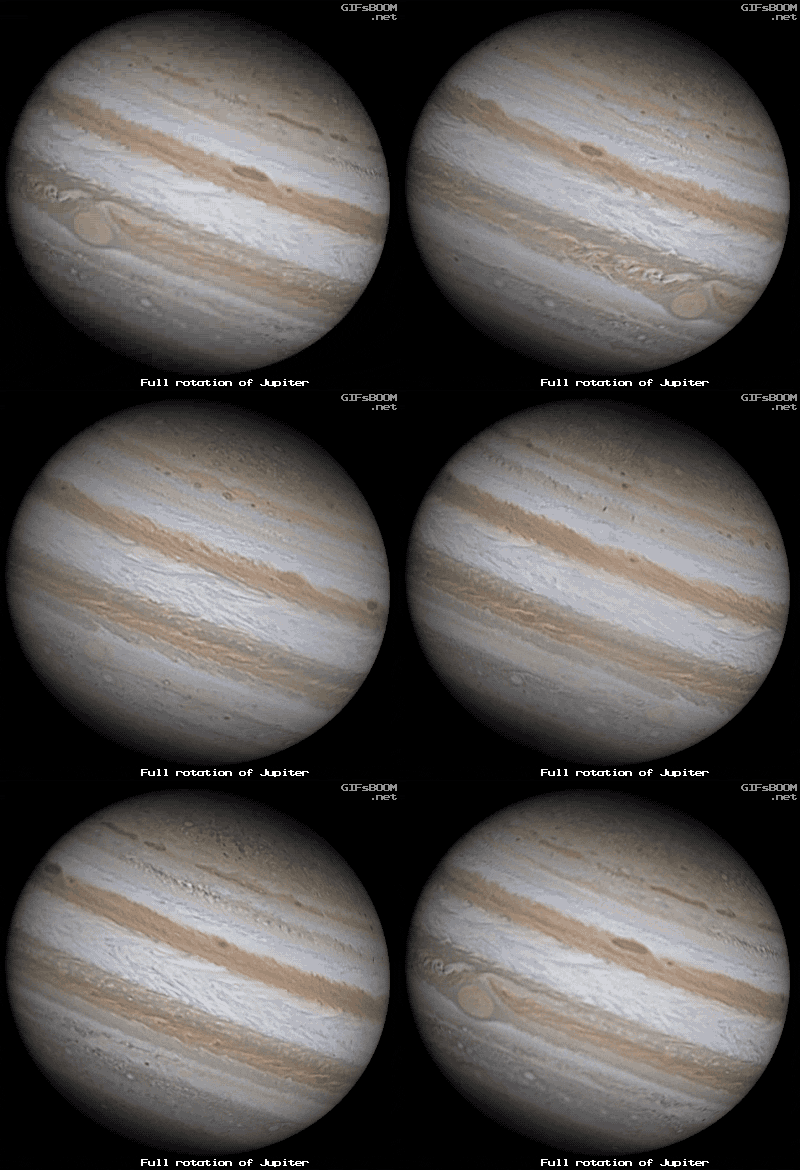
Jupiter’s interior is made of rock, metal, and hydrogen compounds. Below Jupiter’s massive atmosphere, which is made primarily of hydrogen, there are layers of compressed hydrogen gas, liquid metallic hydrogen, and a core of ice, rock, and metals. It's atmospheric environment is one of strong gravity, high pressure, strong winds, from 225 miles per hour to 1000 miles per hour, and cold temperatures of -270 degrees to +32 degrees; I'm already cold just by writing it, brrrr. In the atmosphere there are at least three known cloud decks of ammonia, ammonia-combined-with-sulfur, and water, perhaps even made of huge droplets. There is energy in the environment from lightning, ultraviolet light, and charged particles. Jupiter's interior possesses an environment of pressures as great as three million times the sea-level pressure on Earth, and temperatures as high as 10,000 degrees, so it doesn't seem good for wizards to live there, what a pity.
Jupiter has a thin ring system and they are composed mainly of dust particles ejected from some of Jupiter’s smaller worlds during impacts from incoming comets and asteroids. The ring system begins some 92,000 kilometers above Jupiter’s cloud tops and stretches out to more than 225,000 km from the planet. They are between 2,000 to 12,500 kilometers thick and I think they are very beautiful to look at.

There are 67 known moons of Jupiter, this gives Jupiter the largest number of moons with reasonably stable orbits of any planet in the Solar System. The most massive of the moons are the four Galilean moons, which were independently discovered in 1610 by Galileo Galilei and Simon Marius and were the first objects found to orbit a body that was neither Earth nor the Sun. These large moons, named Io, Europa, Ganymede, and Callisto, are each distinctive worlds. Of Jupiter's moons, eight are regular satellites with prograde and nearly circular orbits that are not greatly inclined with respect to Jupiter's equatorial plane. The Galilean satellites are nearly spherical in shape due to their planetary mass, and so would be considered planets if they were in direct orbit around the Sun. The other four regular satellites are much smaller and closer to Jupiter; these serve as sources of the dust that makes up Jupiter's rings. The remainder of Jupiter's moons are irregular satellites.
Io is the most volcanic active body in the solar system, the surface is covered by sulfur in different colorful forms. As Io travels in its slightly elliptical orbit, Jupiter's immense gravity causes "tides" in the solid surface that rise 300 feet high on Io, generating enough heat for volcanic activity and to drive off any water. Europa's surface is mostly water ice, and there is evidence that it may be covering an ocean of water or slushy ice beneath. Europa is thought to have twice as much water as does Earth, this moon intrigues astrobiologists because of its potential for having a "habitable zone." Ganymede is the largest moon in the solar system (larger than the planet Mercury), and is the only moon known to have its own internally generated magnetic field. Callisto is the eighth moon of Jupiter and is a large, dark but low-density moon which is covered with impact craters. It is home to the Valhalla crater, which is nearly 4,000 km in diameter and the largest crater in the solar system. It is the outermost of the Galilean moons, orbiting 1,170,000 miles from Jupiter. It takes Callisto 16.7 days to complete its orbit around Jupiter and during that time it will have traveled more than seven million miles, quite amazing if you ask me.

Aria Quin Lee here for Gryffindor House, 🍪
SPOILER (click to toggle)
Aria scanned the night sky for a planet to study; she had already decided that she did not want to focus her efforts on a planet in this solar system. Making the appropriate adjustments for deep space exploration, Aria focused her telescope far into the seemingly empty void. After several long exposures, Aria pulled back from the telescope to look at the monitor and found that one area had an immense number of galaxies from which to choose. She chose one galaxy that looked to be quite bright and zoomed in on one of the outer regions. After many more hours she finally located the perfect subject to study.
Tilcarnis System Aria Quin Lee
The universe is full of amazing and wonderful features, many of which scientists have yet to discover. One such planetary system lies in a far distant galaxy that has yet to be named. The unnamed galaxy is known simply as ULAS D2235+0210, which has now been named Valaer, by Aria Quin Lee. Near the periphery of the galaxy Valaer is a planetary system named Tilcarnis, moniker chosen by Lee. The Tilcarnis system is not very unique in structure as it is a binary system, consisting of an orange dwarf with an orbital white dwarf. In the known universe, binary systems have been seen as the more common type of planetary structure than heliocentric systems in which there is only one star.
The Tilcarnis system is comprised of the following planets (all named by Lee):
Tilcarnis system Stars: orange dwarf: Tilcarn - white dwarf: Tillic Planet 1: Afimas, no satelites Planet 2: Trime, 6 satelites Planet 3: Silhartn, no satelites Planet 4: Xenial, 11 satelites Planet 5: Caipil, 2 satellites: Cai and Tath Planet 6: Riquind, 18 satelites
The planet being discussed in further detail in this paper is Caipil. This planet has only two satellites orbiting it, which seems to be an anomaly for the system, as all other planets in the system have either zero or more than six satellites in oribt. Caipil seems to have an atmosphere but it appears to be made primarily of methane and nitrous oxides. The planet revolves rather quickly on its axis, having approximately a 7.5 hour day. The planet needs further time to asses many of its other features.
The two satellites are on an eccentric orbit around their planet Caipil, which causes them to be geothermally active. The eccentricity of the satellites path messages their inner cores, which creates friction heat, which is how the satellites remain geologically active. The two satellites appear to have a thin atmosphere; however the atmospheric composition has not yet been determined.
This new system is sure to cause a great uproar in the scientific community; as many explorers will want to see if these planets fall in the goldilocks zone for habitable earth like exoplanets.
Public Ping Group - Xanadu Galleria and RAE Collab
I really really extremely want:
Polyphemus By Samantha Grant, Slytherin
One of three gas giants and two rocky planets, orbiting Alpha Centauri A, the largest star of the trinary Alpha Centauri system, Polyphemus is famous for its fifth moon, Pandora.
The Alpha Centauri system is our nearest interstellar neighbor, and contains three stars: Alpha Centauri A and B, and Proxima Centauri. Alpha Centauri A and B are both similar to our Sun in temperature and brightness. They follow an elliptical orbit around each other. Proxima Centauri is a red dwarf star, on a long orbit around the two more massive stars.
The two rocky planets that orbit close to Alpha Centauri A are unremarkable and as yet unnamed. The three gas giants were named Oceanus, Coeus, and Crius. Coeus was later renamed, or perhaps nicknamed, Polyphemus.
Polyphemus is the fourth planet from its sun, and is believed to have 14 moons. In addition to the fourteen moons orbiting Polyphemus, there is a large and a small planetoid at the gas giant's L4 and L5 Lagrangian points respectively. Pandora, the fifth moon has a lush biosphere, with a large variety of life.[URL=http://s1043.photobucket.com/user/Chat_Lunatique/media/ACsystem_zpsxbyp9zhk.png.html][IMG]http://i1043.photobucket.com/albums/b435/Chat_Lunatique/ACsystem_zpsxbyp9zhk.png[/IMG][/URL] If image is broken, open in new tab to see.
Polyphemus is a ringless blue gas giant slightly smaller than our planer Jupiter, with less prominent bands and a larger vortex storm. This large, eye-shaped storm is the source of the planet's name, being that Polyphemus is the gigantic, cyclops son of Poseidon and Thoosa.
(Size comparison of Polyphemus and Jupiter.)


Astronomy -Planets and their Moons
Eirik adjusted the dials on his telescope, activating the further distance enhancements. His sight reached magically to the Outer Rim, and he found the Sluis sector, and then the system that he was looking for.
The Dagobah System housed a number of planets and moons, but he was looking for the planet Dagobah itself, with its moon Gus Treta. He smiled as he located it.

While gazing at it, he pondered on how the planet came to get its name. On our planet, Dagobah was a reference to a dome shaped memorial that traditonally held relics of the Buddha or Buddhist saints. Loosely translated, the planet was dome shaped and was purported to hold the beginings of great spirituality.
He adjusted the scope to get a closer look at the planet, and managed to see the upper layers of the planet's atmosphere.

It certainly was beautiful, and reminded him so much of Earth.
Eirik had read about Dagobah in an astronomy book back at Durmstrang, and was fascinated with the planet. He brought to mind the details he had read:
Rotation period 23 standard hours
Orbital period 341 local days
Class Terrestrial
Diameter 8,900 km
Atmosphere Oxygen mix
Climate Murky
Primary terrain Swamp Bogs Jungles Bayous
Surface water c. 8%
Government None
Population None
Major cities None
Major imports None
Major exports None
Yet they had gotten massive life form readings. There had been some images gotten from the huge space telescope outside of Moscow, and from it they had gathered much information, even though no one had been there yet.
From those pictures, they had put together a drawing of what they believed the ecosystem of the planet would be like.

They had managed to get a picture of the actual surface, which was swampy and full of flora.

There were also some strange creatures they had glimpses of, a creature they named a Dragonsnake that lived mostly underwater

a monitor-like creature they called a Sleen

an iguana-looking reptile they called a Nudj

a t-rex looking reptile they called a Picobi

and even some flying reptiles that looked like pterodactyls that they named Bogwigs

Eirik smiled, gazing up at the planet. He thought how wonderful it would be to visit Dagobah in person, even with all the risks. To him, the lush, green world reminded him of a time long past, when his world was young and unspoiled...Nature at it's purest. The wilderness had always been a special place of deep spirituality, and he believed somehow that Dagobah would live up to its name.
~Eirik, House Slytherin


Astronomy
Fade cracked open his notebook and began writing immediately. Astronomy was one of his favorite subjects, aside from Charms, and he couldn’t wait to get started. At the top of the page he scrolled “Mars” in ridged lettering and underlined it. Below he began to compile his essay.
Mars is the fourth planet from the sun and about half the diameter of Earth. Named after a Roman god, it is also sometimes referred to as the “red planet” because of the iron oxide, or rust on its surface that gives it a reddish look. It is one of the terrestrial planets in our solar system, meaning it is made up of mainly rocks and metals. Smaller than it’s siblings with the exception of Venus. Mars has a thin atmosphere with a very similar rotational period to Earth’s. It is also home to the largest volcano, Olumpus Mons, and second highest known mountain in our solar system. Three times the height of Mount Everest.
Water has been found on Mars, but exists primarily in a frozen state on the surface. It can be spotted on the north polar ice caps. Also beneath the ice, but never in a melted state on the planet's surface due to it’s low atmospheric pressure. If the ice caps were to melt however, it is estimated that the water would cover the entire planet's surface thirty six feet deep. Even with water being found on it’s surface, the soil doesn’t make for very good growing conditions. Not to mention the thin atmosphere allows for higher radiation levels than humans are able to tolerate.
Mars has two moons, Phobos and Deimos. They are on the smaller side for moons, and feature irregular shapes hinting that they may well be captured asteroids that got caught up in Mars’s gravitational pull. Phobos is closer to Mars and rotates around it much faster than Deimos. Phobos rises in the west and sets in the east, and rises again after only eleven hours. Deimos on the other hand rises in the easy but very slowly, it takes about two and a half days between its rise and set. Eventually it is speculated that Phobos will crash into Mars.
~Fade, Ravenclaw
Beneath his essay Fade doodles a drawing of the red planet and its lumpy moons.

((I hope this post works, subeta has been eating them recently... I referenced the Mars wiki page, and found the illustration on http://worldartsme.com/mars/))

[img align=left]https://i.imgur.com/DFXTxuq.png[/img]
Eros' Essay
Venus was the easiest planet to locate, given that it shines the brightest. My dad use to tell me about it all the time when I was a kid, and it seems only fitting that the son of a woman name Aphrodite picks the planet Venus. Anyway, it is the second brightest natural object in the sky, second to our moon. The planet can even be seen during a clear and sunny day. And most likely because of how bright it shines, it was named after the Roman goddess, Venus, "bright queen of the sky"...
The planet is about the size as ours. It's also the closest to Earth and has a core, mantle, and crust similar to Earth. Venus, however, rotates signifcantly slower than our planet. It takes about 243 of our days to amount to one day on Venus. Since it spins so slowly, it's magnetic field is weak. Also, it take 225 Earth-days for Venus to orbit the sun. Despite being considered our "sister" planet, it is far from habitable.
In fact, I'd imagine it to be a hell of some sort. For starters, a day is long there, as I've mentioned. It's also the hottest planet in our solar system. Definitely, too harsh and hostile to sustain any sort of life. It has a pressure that is about 90 times that of Earth's. So any small object coming in will be crushed before it can leave a crator on the planet. It's like being 1,000 kilometers under sea level. The planet is very dry and plagued with many volcanoes. There are more volcanoes here, quite a few still active, than any other in our solar system. Mountainous regions make up about a third of this planets and the clouds here are more than likely poisonous. If only there was a portkey or spell to send my enemies to this hellish rock...
Eros Sigurd, Slytherin

[font=mistral]r i p t i d e[/font]

[img align=right]https://i.imgur.com/2fEzsa9.png[/img]
Poppy shivered, glad to have worn her warmest coat and thickest tights. She hoped Astronomy would not prove to be too mathematical this term. The Slytherin dutifully bent over her telescope and sighed. Handling her textbook and writing her essay wouldn't be easy with her good winter gloves on. It was going to be a long and cold night atop the Astronomy Tower.
poppy's essay
Mercury is one of the five bright planets in the night sky, but it is the most elusive to find. You can use Orion's Belt to locate it. The planet is named for the Roman god of communication.
Mercury is the smallest planet, however it is also the second most dense. It has a rocky body like Earth's and is comprised of a crust, mantle, and core. Mercury's surface is not unlike that of Earth's moon, full of plains, basins, and craters. It shows evidence of past volcanic activity, as well as current vast deposits of water ice. Mercury is the closest planet to the sun and the most iron-rich.
Mercury has the most eccentric orbit of all the planets. Someone who is of a "mercurial" temperament is described as "subject to sudden or unpredictable changes of mood or mind." It takes 87.969 Earth days to complete an orbit around the sun. Mercury has no known moons. Poppy Blackwood, Slytherin


SPOILER (click to toggle)
Mars and Earth have approximately the same landmass.
Even though Mars has only 15% of the Earth’s volume and just over 10% of the Earth’s mass, around two thirds of the Earth’s surface is covered in water. Martian surface gravity is only 37% of the Earth’s (meaning you could leap nearly three times higher on Mars).
Mars is home to the tallest mountain in the solar system.
Olympus Mons, a shield volcano, is 21km high and 600km in diameter. Despite having formed over billions of years, evidence from volcanic lava flows is so recent many scientists believe it could still be active.
Mars has the largest dust storms in the solar system.
They can last for months and cover the entire planet. The seasons are extreme because its elliptical (oval-shaped) orbital path around the Sun is more elongated than most other planets in the solar system.
On Mars the Sun appears about half the size as it does on Earth.
At the closest point to the Sun, the Martian southern hemisphere leans towards the Sun, causing a short, intensely hot summer, while the northern hemisphere endures a brief, cold winter: at its farthest point from the Sun, the Martian northern hemisphere leans towards the Sun, causing a long, mild summer, while the southern hemisphere endures a lengthy, cold winter.
Pieces of Mars have fallen to Earth.
Scientists have found tiny traces of Martian atmosphere within meteorites violently ejected from Mars, then orbiting the solar system amongst galactic debris for millions of years, before crash landing on Earth. This allowed scientists to begin studying Mars prior to launching space missions.
Mars takes its name from the Roman god of war.
The ancient Greeks called the planet Ares, after their god of war; the Romans then did likewise, associating the planet’s blood-red colour with Mars, their own god of war. Interestingly, other ancient cultures also focused on colour – to China’s astronomers it was ‘the fire star’, whilst Egyptian priests called on ‘Her Desher’, or ‘the red one’. The red colour Mars is known for is due to the rock and dust covering its surface being rich in iron.
There are signs of liquid water on Mars.
For years Mars has been known to have water in the form of ice. The first signs of trickling water are dark stripes or stains on crater wall and cliffs seen in satellite images. Due to Mars’ atmosphere this water would have to be salty to prevent it from freezing or vaporising.
One day Mars will have a ring.
In the next 20-40 million years Mars’ largest moon Phobos will be torn apart by gravitational forces leading to the creation of a ring that could last up to 100 million years.
Gryffindor
Going Fishing!!! 🐟

"Astronomy Essay"
On Saturn and its' magical properties
First documented by the Assyrians in the 8th Century BCE, the ringed "Star of Ninib", human history has been vastly interested in not only the geography but the magical properties of the planet that is named Saturn. The Ancient Greeks named it "Wanderer" after their agricultural god Kronos and the Ancient Romans named it "Saturn" after theirs. It is this name that endures to the modern era. For several centuries, until the scientists of the 17th century proved otherwise, Saturn was the most distant planet however it is now know as the sixth planet from the Sun.
Saturn is a gas giant composed mainly of the elements Hydrogen and Helium. It has a mass of 5.68 x 10^26 kgs and is 120,536 km in diameter. It has 53 confirmed moons, 9 provisional moons, and over 30 rings. Each year on saturn is equivalent to 29.5 Earth Years. The strong winds which can reach 110m/s cause the atmospheric yellow and gold bands. Saturn's core is a dense mixture of rick, ice, water, and numerous other compounds that have become solid under the intense internal pressure and heat. Liquid metallic hydrogen inside liquid hydrogen surrounds this core.
Saturn's moons are as follows: Pan, Daphnis, Atlas, Prometheus, Pandora, Epimetheus, Janus, Aegaeon, Mimas, Methone, Anthe, Pallene, Enceladus, Tethys, Telesto, Calypso, Dione, Helene, Polydeuces, Rhea, Titan, Hyperion, Iapetus, Kiviuq, Ijiraq, Phoebe, Paaliaq, Skathi, Albiorix, S/2007 S 2, Bebhionn, Erriapo, Skoll, Siarnaq, Tarqeq, S/2004 S 13, Greip, Hyrrokkin, Jarnsaxa, Tarvos, Mundilfari, S/2006 S 1, S/2004 S 17, Bergelmir, Narvi, Suttungr, Hati, S/2004 S 12, Farbauti, Thrymr, Aegir, S/2007 S 3, Bestla, S/2004 S 7, S/2006 S 3, Fenrir, Surtur, Kari, Ymir, Loge, Fornjot, and S/2009 S 1
Saturn symbolises many things for many different cultures and disciplines. For the Chinese, it symbolises rulership and imperial control whilst in astrology Saturn represents the sign of Capricorn, a methodical and purposeful mover. Amongst others, Saturn represents Authority, Transition, Time, Stability, Unrevealed Power, and Death. For the Wizarding world, Saturn is a planet that is tracked vigorously given it's power of manifestation and bringing our intentions to form. Saturn is said to aid in transfiguration, necromantic rituals, protection, and shielding magic. Saturn is often invoked to celebrate the power of the primal and ancient ones, and it is well noted that these rituals work best on Saturdays and are most powerful on a Saturnalia that happens to fall on a Saturday.
 Slytherin
Sources: http://solarsystem.nasa.gov/planets/saturn/indepth http://space-facts.com/saturn/ http://www.whats-your-sign.com/saturn-symbol-meaning.html http://nineplanets.org/saturn.html http://christopherpenczak.com/planetary-magic-7-saturn-karma-and-protection/#.WHRgdLZ97VU http://christopherpenczak.com/planetary-magic-7-saturn-karma-and-protection/#.WHRgdLZ97VU


[img align=left]https://sapi.subeta.net/shared/82328.png[/img] After using her telescope to locate the planet she preferred to write about, from under her winter cloak Luck took out from her bag the necessary items for completing her essay.
Essay
The planet I located is the fourth planet from the Sun, Mars. Mars is known as The Red Planet because of its red-orange appearance, which is caused by iron oxide dust in the atmosphere, also known as rust. The atmosphere is mostly carbon dioxide, while Earth's is nitrogen. Mars also has substantially less surface pressure, 0.6% of that of Earth, as well as gravity, 38% of that of Earth.
A day on Mars is only slightly longer than a day on Earth, by an extra forty minutes. However, Mars takes almost twice as long as Earth to complete one year. After almost two years on Earth, Mars will have completed one year. Mars has the most Earth-like seasons out of any of the planets in the solar system, and because of the longer years, the seasons on Mars are also longer. Mars has a thin atmosphere, which makes for a good range of temperatures: -143C to 35C. Mars has a unique weather element, as it has the largest dust storms in the entire solar system. These dust storms can be so large that they cover the entire planet at once.
Mars has two Moons, which are known as Phobos and Deimos. Phobos appears to orbit closer to Mars, while Deimos is farther away. Phobos orbits the planet very quickly; after it sets below the horizon, it can be seen rising again just eleven hours later. Deimos on the other hand, takes even longer to orbit than Mars takes to rotate. Deimos takes thirty hours to orbit, however, because it is slower than Mars' rotation, after it sets it will take almost 3 days before it can be seen rising again.
Mars is theorized to have once been very similar to Earth, before it lost its magnetosphere and became vulnerable to solar winds, and thus is suspected to have once supported life. Traces of such evidence are still being searched for.
Luck, Hufflepuff.
he/him / 31 / EST |  | My best friend is |

Zay has been fascinated by the solar system from a very young age so this assignment excited her. After gathering her materials and finding her favourite planet through her telescope she took out her quill and began to write.
Astronomy Essay
The sixth planet from our sun is Saturn. It's the second largest gas giant next to Jupiter. The planet only has 1/8th the average density of Earth, but is over 95 times as large. Saturn's core is surrounded by a layer of metallic hydrogen, an intermediate layer of liquid hydrogen and helium and finally a gaseous outer layer. The upper layer has a pale yellow hue due to ammonia crystals. An electrical current runs through the metallic hydrogen layer and is what's thought to give a rise in the planet's magnetic field. Wind speeds on the planet can reach 1800 km/h. The prominent feature of the planet are the rings. There are nine main rings and three arcs that are mostly made of ice particles with rocky debris and dust. Unfortunately due to the gaseous nature of the planet and with an average temperature of -288 degrees, life is unsustainable
Saturn has sixty-two moons, although only fifty-three have been officially named. These do not include the hundreds of smaller moons that are compromised around the rings. The largest and most prominent moon of Saturn is Titan. It's the second biggest in the Solar System and is larger than the planet Mercury and is the only moon of the planet to have a substantial atmosphere. The other named moons are: Encaladus, Mimas, Lapetus, Dione, Tethys, Rhea, Phoebe, Hyperion, Pandora, Pan, Janus, Prometheus, Epimetheus, Atlas, Telesto, Calypso, Daphnis, Helene, Mathone, Pallene, Paaliaq, Polydeuces, Ymir, Albiorix, Anthe, Kiviuq, Siamaq, Ijiraq, Narvi, Bebhionn, Aegir, Bergelmir, Kari, Skathi, Tarvos,Thrymr, Erriapus, Mundilfari, Suttongr, Farbauti, Bestla, Fenrir, Fornjot, Skoll, Jarnsaxa, Loge, Greip, Hyrrokkin, Tarqeq, and Surtur.

Proud Gamer | My best friend is

Planets and their moons – Venus
Rox absolutely hated astronomy. She wasn’t that good at using her telescope at all, so she assumed she would not be able to even find a planet to describe. She sighed and started working on the assignment hoping for the best.
She set up her telescope and looked through it towards the sky. It took her quite some time but eventually she found a planet. She jumped up and wanted to start her essay on the planet, but then it hit her that she had no clue which planet she had just found with the telescope. She looked again and tried to remember what she knew about the planets from her books.
Rox looked at the planet again. This time she noticed that the planet had no moons. She could remember that there were only two planets without moons. She quickly grabbed her book and started to look for more information. And there is was, black on white, Venus. She smiled as she read more about the planet and started to write her essay.
Venus is the second planet from the sun and named after the Roman godess of love and beauty. It’s a terrestrial planet composed primarily of rocks and/or metals. It has the densest atmosphere of the four terrestrial planets, with the atmosphere containing more than 96% carbon dioxide. Venus is the hottest planet in the solar system with a temperature of 863 Fahrenheit (735 Kelvin). The planet may have had oceans at one time, but due to the extreme temperatures the water has vaporized.
Although all the planetary orbits are elliptical, Venus’s orbit is the closest to being circular. The planet completes an orbit every 224,7 days. Once every 243 Earth days Venus rotates clockwise in retrograde, the slowest rotation of any planet.
[OOC: Source for the essay has been https://en.wikipedia.org/wiki/Venus]
Rox Oatwood - Gryffindor

~ Fable, House Slytherin
Fable turned her scope to a planet that has fascinated her since her youth, other than Earth of course. There the beautiful azure globe sat with its dark rings and many moons, Neptune.
She cracked open her Astronomy book to the correct page to reference any facts she might have forgotten and began her essay.
Neptune

Sitting the farthest from our Sun is the eighth planet Neptune. Named after the Roman god of the sea it is the only planet that was discovered not by telescope but mathmatical prediction. Alexis Bouvard deduced its existence due to unexpected changes in the orbit of Uranus. Finally on the 23 of September in 1846 it was observed through telescope by Johann Galle.
Neptune's axis and gravity are very similar to that of Earth's. Its Orbital period is 165 years with an average day length of 16 hours and 6 minutes and seasons that last 40 Earth years.
Neptune has a total of 14 moons in all. Its largest moon, Triton, was discovered shortly after the planet's discovery, though none of the planet's remaining 13 'known' moons would be found until the 20th century. Triton is the only major moon that orbits "backwards" and holds the title of coldest region in our Solar System. The other 13 moons are as such; Naiad, Thalassa, Despina, Galatea, Larissa, Proteus, Nereid, Halimede, Sao, Laomedeia, Psamathe, Neso and the newest s/2004 N1. All except the newest moon were named for lesser sea deities.

Neptune has a faint and fragmented ring system that is considered relatively new. Scientists believe that they could possibly have been created due to a moon colliding with the planet. Many of Neptune's smaller moons orbit inside its rings. The rings are dark in color, in contrast to Saturn's, and are known to contain ice as well as many other elements.
Most fascinatingly is the atmosphere of planet Neptune. Due to its great distance from the Sun it surprisingly has the strongest winds in the Solar System, clocking at 2000 km/ hour. This is special due to most wind formations needing the energy from the sun to be created. Neptune uses its internal heat source, which radiates more then twice as much energy as it receives from the Sun, to generate the powerful storms and vortice's.
Neptune has valleys, volcanoes, and craters and is considered one of the coldest places in our Solar System. Also due to the extreme pressure on the planet and chemical components in its atmosphere, Neptune has rain storms consisting of giant diamonds.
In closing, a fun thought, due to Neptune's presence of water in the form of ice, it is hypothesized that the planet could potentially contain life, be it somewhere between the frigid cold (-360.4 F) and the extreme heat of its core (9260.33 F), due to all water containing some form of life but until a new expedition is formed no one can know for sure!
[img align=right]https://i.imgur.com/lCJSVpA.gif[/img]

Outfit Not Found
Mac was grateful for Magnus' gift of warm gloves and sweaters. It was terribly cold atop the Astronomy Tower. And, secretly, Mac was a little disappointed that she would not be learning any magic in her very first class. But she had never used a telescope before, and when she looked into the eyepiece, she could not help herself, "Ooooohhhh!" she gasped. For the first few minutes, Mac could not even concentrate on her assignment, she just stood there gazing at the starry skies.
Finally, she remembered that there was work to do.
Essay by Immaculata Marie Laveau, Ravenclaw (Mac)
82 G. Eridani (HD 20794, HR 1008, e Eridani) is a star about 20 light years away from Earth in the constellation Eridanus. It is known that there are three planets orbiting 82 G. Eridani. The mass range of these planets classifies them as super-Earths; objects with only a few times the Earth's mass.
The second planet of this system is Truncheon, the "Pummeler" It is named this because of its rapidity of orbit. Despite being 98 billion miles from the surface of 82 G. Eridani, the Truncheon orbits its star once every 49 days. However it rotates very slowly on its axis, producing no measurable magnetic field.
The Truncheon has 3 moons with slightly perturbed eliptical orbits. The largest of the Truncheon's moons is Verne, next in size is Asimov B, and finally, and controversially is the third moon, Heinlein. Heinlein has an erratic orbit, and can not be consistently viewed, even through the most powerful telescope on Earth. This has led some scientists to speculate that Heinlein might not be an actual moon, but rather a cloud of dust and hot gas.

 Kyros glanced at the night sky with his telescope, wondering which planet should he choose. He had always been fascinated by astronomy, looking up to the sky since he was a smile child. There were just so many planets to choose from... He pondered over the matter slightly, until that beautiful red glow caught his eye, and he knew what he should do.
Astronomy Essay, by Kyros Riven, House Slytherin
Mars is the fourth planet to orbit the sun, after Mercury, Venus and Earth. In ancient history, it was frequently associated to war due to its red glow in the night sky, being currently named after the Roman deity of war and bloodshed. For Korean, Japanese and Chinese people, it was the Fire Star, a herald of grief, war and murder. For the Babylonians, its name was Nergal, after the deity of fire and war. For the Egyptians, it was Horus the Red, for Hebrews, “the one who blushes”, and for the Hindu traditions, the deity Mangala, born from Shiva’s sweat. In modern cultures, it is representative of youth and masculinity. The symbol of the planet Mars is also commonly used to symbolize the male gender. In astronomy, Mars is the regent planet of passion, drive, ambition and sexuality, It's a planet closely related to energy and motivation.
Said red glow is due to the high concentration of iron oxide in its surface, an interesting fact given Mars’ ancient connection with the element iron in alchemy. Mars’ orbital period is approximately 687 Earth’s days, about 1 year, 320 days, and 18.2 hours. Its rotation period lasts for about 24 hours, 39 minutes, and 35.244 seconds, only slightly longer than an Earth day. Its axial tilt is 25.19 degrees relative to its orbital plane, and due to said tilt, which has a similar inclination to the one found on Earth, seasons in Mars are hence similar to Earth’s own, though lasting approximately twice as much due to the longer orbital period. Mars has the second most pronounced orbital eccentricity in the Solar System, after Mercury; as such, Mars’ orbit is much more elliptical, thus lasting longer, than Earth’s. It is theorized that gravity for nearby Earth and Jupiter affect Mars’ orbit, which could explain the gradual increase in its eccentricity during the last millennia.
Mars has two small moons: Phobos and Deimos. Both are slightly larger than asteroids, and are named after Mars’ mythological sons, the gods of fear and panic. Their origin is not fully known, though asteroids being captured by Mars’ gravity is a fairly accepted theory. Both have circular orbits around the planet’s equator, with Phobos’ being unstable due to being closer to the planet itself. It is theorized that Phobos may crash into Mars' surface or shatter into smaller objects if it gets closer to the planet.
Kyros Riven, House Slytherin


Millie groaned. She would often stare into her telescope but wouldn't see anything besides her eyelashes. "Okay, let's try again." She moved her telescope around and messed with the dial until she saw something. She messed with the fine focus and looked again. She looked at her book and back into her telescope. "Oh, that must be Uranus. How pretty." She went back to her book and started reading. "Okay. Let's do this"
Uranus
Uranus is the 7th planet away from our sun. It has the third-largest planetary radius and fourth-largest planetary mass in the Solar System. Uranus is similar in structure to Neptune.Both have different chemical composition from that of the gas giants, Jupiter and Saturn. For this reason, scientists often classify Uranus and Neptune as "ice giants" to separate them from the gas giants.
Uranus is named after the ancient Greek deity of the sky Uranus, the father of Cronus (Saturn) and grandfather of Zeus (Jupiter), which in Latin became "Ūranus". It is the only planet whose name is derived from a figure of Greek mythology
Uranus's atmosphere is similar to Jupiter's and Saturn's in its primary structure is hydrogen and helium, but it contains more "ices" such as water, ammonia, and methane and with traces of other hydrocarbons. It has the coldest atmosphere in the Solar System, with a minimum temperature of 49 K (-371.92 F) Uranus has a complex, layered cloud structure with water thought to make up the lowest clouds and methane the uppermost layer of clouds. The interior of Uranus is mainly composed of ices and rock.
Uranus has 27 known moons. The names of these satellites are chosen from characters in the works of Shakespeare and Alexander Pope. The five most commonly known moons are Miranda, Ariel, Umbriel, Titania, and Oberon. The others include: Caliban, Sycorax, Prospero, Setebos, Stephano, Trinculo, Francisco, Ferdinand, Cordelia, Ophelia, Bianca, Cressida, Desdemona, Juliet, Mab, Portia, Rosalind, Margaret, Perdita, Cupid, Puck, and Belinda.
The largest of Uranus's satellites, Titania, has a radius of only 788.9 km. They are ice–rock conglomerates composed of roughly 50% ice and 50% rock. The ice may include ammonia and carbon dioxide. Among the Uranian moons, Ariel appears to have the youngest surface with the fewest impact craters and Umbriel's the oldest. Miranda has fault canyons 20 kilometres deep, terraced layers, and a chaotic variation in surface ages and features.
There are thirteen distinct rings are presently known, the brightest being the ε ring.The rings are composed of extremely dark particles, which vary in size from micrometers to a fraction of a meter. All except two rings of Uranus are extremely narrow – they are usually a few kilometers wide. The rings are probably quite young; the dynamics considerations indicate that they did not form with Uranus. The matter in the rings may once have been part of a moon (or moons) that was shattered by high-speed impacts. From numerous pieces of debris that formed as a result of those impacts, only a few particles survived, in stable zones corresponding to the locations of the present ring.
The axis of rotation is approximately parallel with the plane of the Solar System, with an axial tilt of 97.77°. This gives it seasonal changes unlike those of the other planets. Near the solstice, one pole faces the Sun continuously and the other faces away. Only a narrow strip around the equator experiences a rapid day and night cycle, but with the Sun low over the horizon. At the other side of Uranus's orbit the orientation of the poles towards the Sun is reversed. Each pole gets around 42 years of continuous sunlight, followed by 42 years of darkness. Near the time of the equinoxes, the Sun faces the equator of Uranus giving a period of day and night cycles similar to those seen on most of the other planets. In contrast to the other planets, whose motions around the Sun resemble that of spinning tops, Uranus's motion can be visualized as that of a ball rolling on the ecliptic plane near solstices and of a spinning rifle bullet near equinoxes.
Uranus reached its most recent equinox on December 7, 2007
source: Wikipedia
Amelia Tudor, Hufflepuff

Outfit Not Found
Feeling small again whilst looking though the telescope Beren decidesto write her essay on something she has thought about for a while....
A Planet, or not a planet,
that is the question – astronomy essay by Beren, House Slytherin
The Dwarf Planet
Pluto, in astronomy, a dwarf planet and the first Kuiper belt, or transneptunian, object to be discovered (1930) by astronomers. Although Pluto was long regarded as a planet, following the discovery (beginning in 1992) of other Kuiper belt objects, including one with a diameter larger than that of Pluto, astronomers recognized the need to reclassify Pluto, and in 2006 the International Astronomical Union (IAU) ended official recognition of Pluto as a planet.
Pluto was the only planet to be named by a kid. After the planet was discovered in 1930, an 11-year-old girl who lived in Oxford, England, by the name of Venetia Burney, suggested that this new planet needed to be named after the Roman god of the underworld. Venetia's grandfather sent this suggestion to the Lowell Observatory and the name was accepted.
Pluto is smaller than 7 of the moons in the Solar System. It is about two-thirds smaller than Earth's moon. Because it is so small, many scientists don't consider it a planet at all. In 1999, a group of scientists attempted to re-classify Pluto as a comet. On August 24, 2006, Pluto's status was officially changed from planet to dwarf planet. For decades, children have been taught in school that there are nine planets in our Solar System. However, with this change, there are now only eight planets. Also because of this change, there is a new category of small planets known as plutoids.
The Hubble Space Telescope has provided the clearest images yet of this dwarf planet for scientists to study. Studies of Pluto and its moon are still being conducted today with the Hubble Space Telescope. However, little is still known about Pluto and its moons because it is so far away.
Pluto has 5 moons. The largest is named Charon. Charon is only slightly smaller than its parent Pluto. For this reason, Pluto and Charon are often called a double planet system. The Earth and its moon, Luna, are sometimes considered double planets. Pluto's two other moons are called Hydra, Styx and Nix. The newest moon, only recently discovered by the Hubble Space Telescope in the summer of 2011, is temporarily named Kerberos. It is located between the orbits of Nix and Hydra.

Pluto revolves around the Sun in an orbit that is not exactly circular like the rest of the planets. Rather, Pluto's orbit is more of an oval or egg shape. Because of this, Pluto will orbit inside of Neptune's orbit, which makes Pluto closer to the Sun than Neptune at times. Also, its orbit does not lie flat in the same plane as the rest of the planets. Pluto's orbit is tilted so it orbits above and below the other planets' orbits in our Solar System.
"I am the character you are not supposed to like." Alan Rickman
[img align=right]https://i.ibb.co/LpJ5BWm/Avatarklein.png[/img]