Astronomy #3 - Planets and Their Moons
Filter
Show Official Posts OnlyReplies

Elizabeth didn't need much time to spot the bright red planet on the night sky and quickly settled for it. She has always found Mars quite beautiful.
Planet Mars and its moons - by Elizabeth Amalia Covington, Slytherin
Mars is often referred to as the 'Red Planet', given the fact that iron oxide, which make a reddish colour, dominate its surface. It's the fourth planet from the sun and after Mercury the second-smallest planet in our solar system. Mars is named after the Roman god of war . The terrestrial planet has a thin atmosphere and an interesting surface and also polar ice caps like the Earth. It also has a similar rotational period and seasonal cycle to those of the Earth, therefore it has four different seasons. One day on Mars, a Martian day ('sol'), is a bit longer than one day on Earth as it rotates in 24 hours and 37 minutes. As Mars is not as close like the Earth to the Sun, it receives just 43% of sunlight and one Martian year is roughly two Earth years long.
Mars features impact craters of the moon on its surface, along with valleys and deserts. It's roughly half the diameter of Earth and less dense than the latter one. It has a mass of 6,419 · 1023 kg and the temperatures of the atmosphere differ between -133 °C to 27°C, the mid-temperature is -55°C. It consists of carbon dioxide(95,97%), nitrogen(1,89%), argon(1,93%), oxygen(0,146%), carbon monoxide(0,056%) and water (0,02%). The planet's crust has an average thickness from 50 km to 125 km.
The geological history of Mars is split in three main periods, which are Noachian period, Hesperian period and the youngest and on-going one, the Amazonian period. Mars is still full of geological activity and it has the largest volcano in the solar system. It also has the highest mountain in the Solar system, which is the Olympus Mons, which is 27 km high. The third largest rift system, the Valles Marineris, is also situated on Mars - and it's 4,000 km long. It has been struck by some asteroids over time which shaped its appearance with large craters.
Mars has only two moons, Phobos and Deimos. Phobos is the bigger one and the name derivates from Greek mythology in which Phobos ('Phobus') is a companion to Ares (the Greek term for Mars). It also means 'dread'. 'Deimos' is the smaller one of the moons and also more distant to Mars. Its name is originated in Greek mythology as well as it was the twin brother to Phobos and impersonated 'terror'.

OOC; the above image is drawn by me. drag in url-bar for full-view
After finishing the essay, Elizabeth even had some time to draw the planet and its moons she had observed in the night sky.

Vivian fiddled with her telescope for a long while. It wasn't enough to look at the closest planets; after all, those had been her childhood friends for a long time. Why not take it up a few dozen notches and look at someplace she hadn't looked at yet? Someplace mentioned in the Muggle astronomy books?
The Wolf Planet
Wolf 1061c is a rocky Super Earth-sized planet approximately 13.8 light years from here, orbiting a dim little red dwarf star sadly just referred to as Wolf 1061 by Muggles. This solar system can be found in the constellation Ophiuchus; some might remember this is the famed and controversial "thirteenth zodiac sign" from the sidereal zodiac, which is not as commonly used as the tropical zodiac and thus is often discounted for purposes of divination. Wolf 1061c is located inside the area of its solar system necessary to sustain life; close enough for warmth, far enough away to not fry the surface. It's surface is not plagued by tectonic turmoil like Venus or some of the Galilean moons, and offers stable conditions for life habitats. Its average temperature is slightly warmer than Mars yet cooler than Earth's, so relatively temperate.
This is third closest habitable planet to Earth, although the lighting is quite gloomy from the sun and probably no one should like it very much. Wolf 1061c is so much closer to its tiny sun than Earth that it only takes the equivalent of 17.9 Earth days to complete an orbit around (in other words, a Wolf year). The other problem with living there is since it's so much bigger than Earth, it likely has greater gravity, and everyone should feel smushed. I for one should not like to experience 1.6 gees outside accelerating on a broomstick or a carnival ride. Feeling that just walking around should be unpleasant.

Outfit Not Found
Lenore sits on the astronomy tower and pulls out parchment and her usual green-black ink. She doesn't bother with a telescope as she knows it would be useless.
Lenore - Slytherin House
There is one planet that has captured my attention though I have never seen it. It is the planet Venotin and it was discovered by my great-grandmother, or so she claimed. My great-grandmother was a Seer and though no one could ever find Venotin by any means known to wizard kind, she maintained to her dying day that it was out there, having been revealed to her while in a trance. Whether it truly exists or is simply the delusion of one woman, Venotin is a very interesting planet.
According to my great-grandmother the planet of Venotin is pale purple in color when viewed from a distance. This color is the very dense outer atmosphere. The surface is entirely water. Unlike the blue waters of Earth, Venotin's water is perfectly clear no matter how deep. Exactly what property makes this possible is unknown. While there is no land on Venotin, there is a great quantity of floating cities made up of amber tinted glass. These cities are inexplicably unpopulated.
Venotin is a free roaming planet and does not remain in one place or in one pattern of orbit. It travels throughout the Milky Way galaxy at random. If one were to stand in one of the glass cities of Venotin and look out through a telescope, the view would never be the same twice. Due to this constant movement, Venotin has no moons of its own but may come close to any number of moons belonging to other planets.
While the existence of this planet seems unlikely, it is interesting to think that Venotin may truly be out there.
Currently selling:

Roree Edis, Ravenclaw
Roree smiled broadly. She was so excited the professor said they could use a fictitious planet. She knew just the one she was going to use in her essay. She happily grabbed her ink, quill, and parchment out of her school bag.
Roree's good mood suddenly turned sour. Upon learning that the fictitious planet she had wanted to use did not cover all the questions the professor had asked the class to cover, Roree settled on writing her essay on a real planet.
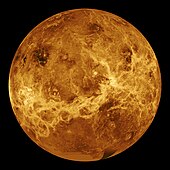
Venus
Venus orbits around the sun in 225 day. This means a year on Venus only lasts 262 days. Venus' orbit is 108,200,000 km from the sun. The planet has no moons.
Venus' surface seems to be shaped by extensive volcanic activity. Venus also has several times as many volcanoes as Earth, and has 167 large volcanoes that are over 100 km across. This is from the planets lack of plate tectonics. Venus does not experience rainfall except in the form of sulfuric acid.
Venus has an extremely dense atmosphere which is made up of primarily carbon dioxide and some nitrogen. Venus is the hottest planet in our solar system with temperatures such as 462 degrees Celsius (or 863.6 degrees Fahrenheit. The atmosphere is composed of thick clouds of sulfur dioxide.
Ancient cultures knew about Venus, but believed it to be two separate celestial objects; the morning and the evening star. The Babylonians eventually discovered these two "stars" to be the same object. It was not until the sixth century BC that this was a scientific understanding.
Many cultures have identified the planet with their respective goddess of love and beauty. Venus is the Roman name for the goddess of love, while the Babylonians named it Ishtar and the Greeks called it Aphrodite. The Romans also designated the morning aspect of Venus Lucifer (literally “Light-Bringer”) and the evening aspect as Vesper (“evening”, “supper”, “west”), both of which were literal translations of the respective Greek names (Phosphorus and Hesperus).
The transit of Venus in front of the Sun was first observed in 1032 by the Persian astronomer Avicenna, who concluded that Venus is closer to Earth than the Sun. In the 12th century, the Andalusian astronomer Ibn Bajjah observed two black spots in front of the sun, which were later identified as the transits of Venus and Mercury by Iranian astronomer Qotb al-Din Shirazi in the 13th century. By the early 17th century, the transit of Venus was observed by English astronomer Jeremiah Horrocks on December 4th, 1639, from his home. William Crabtree, a fellow English astronomer and friend of Horrocks’, observed the transit at the same time, also from his home. When the Galileo Galilei first observed the planet in the early 17th century, he found it showed phases like the Moon, varying from crescent to gibbous to full, and vice versa. This behavior, which could only be possible if Venus’ orbited the Sun, became part of Galileo’s challenge to the Ptolemaic geocentric model and his advocacy of the Copernican heliocentric model.
🌸 || || 🌸

Paddy - Gryffindor
Paddy hadn't got to grips with Astronomy in the previous terms, but there was a planet on her chart which drew her attention - something a little different to the usual ones that she'd tried locating before. Picking up her quill, she began to write her essay....
I chose to locate the planet Lupinerium which was discovered by Romulus Lupin (no relation to the famous Professor) in the year 1735. Its environment is not unlike that of Earth, although the majority of the planet has at least 15 hours of darkness all year round, with just one part getting just four hours of darkness due to the planet's unusual orbit. It has three moons, Romulus (named after its discoverer), Gytrash and Skriker. Nobody knows why those last two moons have such strange names, although there is a possibility that R. Lupin was influenced by the local rumours of a large black ghostly dog that was said to haunt the local graveyards.
The fact that this planet has so much darkness was no doubt a factor in its 'lupine' style of name, and also the canine-themed names of its moons. Although you would think the darkness would give a cooler temperature, the average is in fact around 20 degrees C. However nobody so far has been able to accurately measure the maximum temperature, and this is all done on what the astronomers describe as "educated guesswork".

My CW shop ~ forumset by [/font]

Gryffindor Ambition - 15 points Chook - 15 points Paddy - 15 points Rox - 15 points
Slytherin Anne - 20 points Beren - 15 points Evelin333 - 15 points Fable - 15 points MerlinPendragon - 15 points Moonfox - 15 points Nik - 15 points poppet - 15 points Riptide - 15 points Turokai - 15 points Twilight_Wanderer - 15 points
Ravenclaw Cheshire - 15 points Pagan - 15 points Raggy - 15 points Raven - 15 points Zay - 15 points
Hufflepuff Luck - 15 points Tardis - 15 points