Need advice: Not sure what methods to follow in practicing
Replies

Hello!
I started drawing at a very young age, possibly 2 years old or younger, and would draw all the time when I was a child. However, as I got older I started to draw less and less with less variety in the things I drew. I remember that by 12 what I mostly drew were persons (mostly girls) in anime style and without variety in poses or portrait positions. Few years later I started to draw anime characters by looking at the pictures and drawing what I saw. I was good at it but at the same time it bothered me that I was too slow in drawing that a simple picture would take me days and I didn't really enjoy the process because I worried too much over "perfection". Another thing that bothered me was how the pictures I drew from my mind looked very poor in comparison. I didn't have the ability to draw my personal characters because of that.
Few years ago I became interested in drawing real people in my own (anime-ish) style (I had gotten a drawing tablet years earlier so would do these digitally). There's an embarrassing story of how I got this tablet at 16 and I'm 22 years old now and only recently found I had been making it way harder for myself because I didn't look at tutorials and so didn't know the simple basics of the drawing programs but I'll keep this for later. ^^;
My problem with drawing real people in my style is that I don't really have an art style and I also feel the faces I do don't have proper proportions and never really look the way I want them to be. I struggle a lot to do faces unless I'm looking at a reference and drawing the face as I see it. I have an idea in mind of what I want my art style to be but I don't have the ability to do it on paper or to even picture it in actual detail of how things should look like. This problem caused drawing to be a painful process where I keep repeating "you suck!" in my head instead of enjoying myself. Recently, I figured out a solution to a part of my problem. I realized that I actually spent more time in erasing than in drawing and decided I would challenge myself by doing full body sketches with a color pencil where I wouldn't allow myself to erase at all. That actually worked better than I had expected which raised my self-esteem a bit, and I know I needed to practice drawing full bodies, but my problem with faces still remain (I do these without a face).
I had read somewhere many years ago that starting with the eyes first is easier and had followed this tip for most of my life. I recently found however that this actually was one of the reasons I struggled and it would control the size of my drawings on the paper forcing me to continue the drawing bigger or smaller than I had wanted. I decided to start with the head first but it made faces even more of a struggle to do because I'm not used to it at all and don't know how it works.
I know that my lack of practice throughout the years is what led me to be struggling like that, but at this point I'm really not sure how exactly should I practice. Like what methods should I follow to improve. Will practicing drawing full bodies without faces eventually lead me to be able to draw faces in my own style without struggling a lot only to end up with something that doesn't look like what I imagined and doesn't have proper proportions? I honestly lost motivation because I'm so angry at myself. I'm also really upset over the fact I still don't have the ability to draw my personal characters. I have their designs in my head but don't feel my abilities are enough to put them on paper since there's no reference for them anywhere. I just don't trust my drawing abilities unless I'm looking at something and drawing it.
I have a DA but I feel too embarrassed to link it here. (I also haven't uploaded anything to it since last year because I realized I worry less over "perfection" and so struggle a bit less when I draw without having uploading the drawing in mind). I hope that's alright. ^^;
Sorry for how long that was!

Thing is you have to start outlining the shape of the whole thing. So you don't start eyes. you start from the general ideea of what you will draw. Also if you feel they look unnatural it is because you skipped learning proper anatomy. No worries it is commoun. Even the most cartoonish style needs proper grasp of anatomy. Is it easy to learn? No. True struggle. but it is the only thing that can help make everything not appear stiff and awkward. I am not good at explaining so I will leave some resources and a better explanation than I can provide.
This link is also useful on how to register progression and she is overall very helpful: click [ /url]
And this link has good references for anatomy. Remember don't use other drawings to learn anatomy. You add your mistakes to another person and end up having more of them. Always use an actual human or dog or flower to reference practice anatomy. If you can get someone in real life to pose for you even better. [url=http://www.senshistock.com/sketch/#] click
Don't be afraid of mistakes and oddities in art. Consistency only means you are not progressing. Never strive for consistency strive for growth, Good luck.

It looks like you've already tried practicing, so the generic answer of "Just practice more, you'll get there! Progress is not meant to be easy," obviously won't work for you.
What I see here from what you've wrote is that you're experiencing fatigue. Sure you're not supposed to get good immediately, but not seeing any results that you want can be a big motivation killer.
My advice is: don't fight it. Figure out what works for you, find a concrete end goal, and break the process into steps to get there. It is also a problem of work ethic. If in general, you get anxiety, then you'll find it hard to work, and art is work. It's important to focus on your mental health first, as the foundation for creating good work.
Here is a quote by Ira Glass on when your art doesn't match your mind's eye or your expectations, I recommend it.
You said you have no problem referencing things, but when it comes to drawing on your own, you find yourself at a loss. This is usually a problem of not knowing how to break things down into their basic shapes, and understanding the 3d form in space. Anatomy. Learning muscles will help a lot. I agree with Ravel here, if you reference other artists, you'll add their mistakes to your own so it's better to start fresh - with the real world around you.
If you need tutorials, I think Prokos on Youtube and Manga_Materials on Twitter will help. You may already know these, but if not, they are good revisiting.
Art style will always come last so I don't think it's something to worry about now. Instead of having a vague goal in mind "I wanna draw good enough to draw my OCs," try thinking in terms of concrete goals, like: "I see I need to get better drawing faces, so I want to start with faces." But even that might be too big, so instead break it up into even smaller chunks, like "I want to get face proportions right. After that, I will try drawing the same proportions in different angles." You just have to make goals that allow yourself to see progress and overcoming challenges. Allow yourself to have mini accomplishments along the way.
If you're having problems with erasing too much, the "Draw a Box" method of instruction may work for you. They're main focus is on pen drawings, meaning you don't erase, you plan ahead, make your mark, and move on. The biggest problem with Draw a Box though, is that a lot of artists tend to get lazy with the boxes and don't really fully commit to the lesson. Then they say "Why am I not drawing gud???" Well they didn't follow the lesson. The lesson failed them.
There's also nothing wrong with just taking a break. It's easy to think that "Oh, if I don't practice everyday, I will never catch up" but like exercising your muscles, you need to take breaks to let your muscles recover. Here's the important part, even when I'm not drawing with my hands, I'm studying by looking at things. Exercise different muscle groups so you can train your full body, when different parts of your body is tired. When you aren't drawing, you can (for example) take food pics for your instagram/etc to better understand framing and composition, or collect color palettes. That way you aren't just sitting stagnant when you hit an art block.

There is a lot of good advice here, but I would like to add my own bit if you don’t mind.
Instead of focusing on ONE thing, ex: eyes, hair, arms, legs. Focus on the entire shape of the subject. Composition can make or break an illustration.
There are many useful proportion tutorials online, and on youtube that have helped me. Zooming out and drawing with a bigger brush (digitally) helps keep me from trying to detail something too early.
Aside from all that, I would encourage you to compile a list or a collage of artists who you admire and look up to. Spend some time studying what part of their art you like the most. If you like how someone draws eyes, see if you can’t mimic the style. You can also learn a lot from tracing, and while I will not ever tell anyone to trace and claim the work as their own (that is just bad karma) As a private learning tool tracing will teach you things you may never learn on your own. If sketching from a photographic reference isn’t working, maybe make a layer over the photo and trace it to see where your own lines are not matching up. I’m linking an example of something I worked on in October just for a visual reference. Am I proud of the art? Not really, but am I learning from it? Absolutely. Also if you ever have questions or want to chat I am here for ya! I love encouraging people to be creative and express themselves.
SPOILER (click to toggle)
Process: 1) messy sketch 2) shape blocking 3) line art 4) shadow
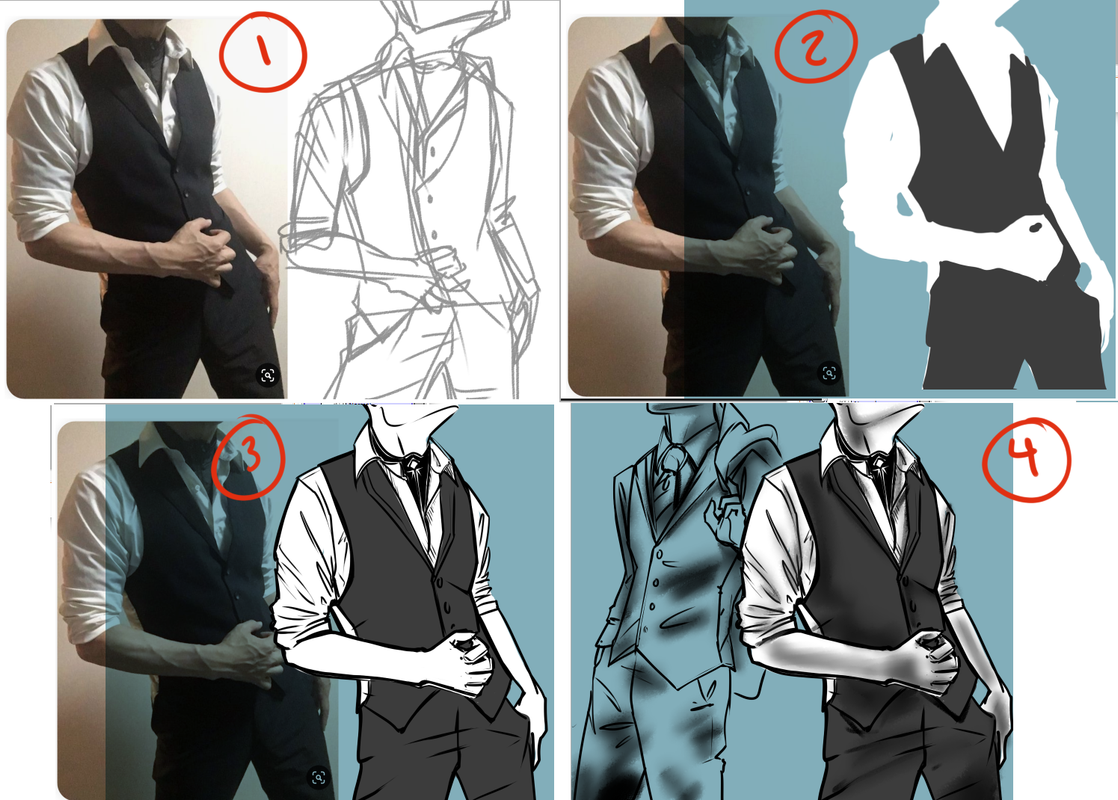 Final: Added color and "highlight" and "lowlight" lines for depth...
