Let's talk web lingo
Replies

Hi all!
I'm a senior in college studying graphic design. For my thesis project, I'm writing and designing a book about the language of the internet. Here's where you guys come in. I'm looking for other perspectives and experiences of how people treat language on the web, whether it's forums, social media, etc. I would really love to hear about how you use web speak.
Here are some general questions to get the conversation going: Do you use text speak (thx, u, etc)? Do you use acronyms or abbreviations? How do you use punctuation? Do you use emojis or gifs, if so, are they punctuation, supporting imagery, something else? Do you reference memes or gifs in conversation? Does internet culture influence how you speak in real life? What comes to mind when you think about web speak?

Edit: btw im a 20 year old female college student from the united states. hi(: i'll help you out! something i find interesting is that my typing has changed a lot over the years. I used to be a real stickler for capitalizing, punctuation, grammar etc but i've gotten way lazier since I have a smartphone; sometimes autocorrect and whatnot can be so frustrating that i stop caring about what shows up in my texts. the people close to me can usually figure out what i mean. however, i'm an english tutor, so when i'm texting someone who's esl i have to be more careful so they don't adopt my bad habits. i have to be a model for them. even so, i hate the work my cellphone sometimes makes me do... it can prove to be not such a "smart" phone hahaha
-i do use text speak such as thx, pls, u, tho, lol/lmao/lel, wbu, omw, and others. -abbreviations i often use would be prof for professor, hw for homework, ppl for people, abt for about. instead of writing out 4:30 am i will often write 430am. i also use shortcuts when i'm texting in spanish, tho i don't know many of those. -im usually pretty consistent with punctuation. i sometimes leave out periods, question marks, and commas. i almost always leave out apostrophes. i use very long ellipses, hahaha -i use more emojis than gifs, i use emojis constantly and they are a crutch haha. if there is no emoji feature i tend to use text-based ones and sometimes my messages and emails feel weird to me if i dont have them :p -a lot of the jokes i make with friends do reference memes, gifs, and emojis. -internet culture has everything to do with how i speak in real life and i think that's true for a lot of people; some ppl might not even realize theyre making internet references when they talk. and yeah i'm that terrible person who says "L.O.L" out loud at times. -web speak makes me a little sad tbh because, like swearing, maybe it's a sign that our words are less creative so our ideas and our brains are going down the same path...hmmm
[img align=center]https://media1.tenor.com/images/d7709cf410e3b580f243f896b40cb113/tenor.gif[/img]
Thank's for responding! I really appreciate hearing other viewpoints and experiences. I totally remember when traditional grammar rules was the go-to on the web (it was some time after everyone started texting with flip phones) for whatever reason people seemed to decided it was lazy to write in short hand. I'm curious about your texting in Spanish! I have a somewhat limited view, as I am only an English speaker, but I'm really interested in how webspeak is used in other languages. For example, there are a ton of lol or haha equivalents in other languages. You're not terrible for using internet lingo in real life speech! Actually, the use of lol in current language is sort of an empathetic notation (definitely not laugh out loud anymore). It totally makes sense that we would start using it in real life since that concept was basically missing from English. As for your last point, in my opinion, web speak is basically the opposite of us being less creative. In fact, there is a school of thought that webspeak is an attempt at mimicking spoken conversation since so much communication is now digital. People are finding new ways (like using emojis the way you described) to show their tone, sarcasm, etc.
Hey guys would love some more perspectives!

I do find it interesting that by using emojis and expressions like hugs etc. we have the ability to express tone, feeling, and body language.
Public Ping Group - Xanadu Galleria and RAE Collab
I really really extremely want:
hmmm, I see your point. It's definitely true that only pictures would dampen a person's ability to verbally express emotions. However, I don't actually think emojis and * actions are replacing words. In my research, emojis particularly, are usually an additional piece not a replacement. You even mentioned that you always put words in front of emojis. So in your hypothetical, while what you explain would be worrying, I think Julie would probably know not to use hugs and emojis and would instead offer verbal support. There's certainly some subconscious understanding of when it is appropriate to use webspeak. Your description of using traditional grammar in emails also agrees with this idea. We seem to understand, such as on forums like this or emails, that there is a more formal atmosphere and thus webspeak shorthands are not appropriate. It's interesting to know that you use traditional grammar even in casual texts. Do you mind telling me your age range/gender? There does seem to be some correlation between age and using webspeak. In reference to your punctuation use, that is a really interesting blend of traditional and web 'rules,' especially your use of periods as sentence enders, which is rarely used in webspeak, but using periods to denote anger, which is very commonly used in webspeak.
Also most of my friends and associates use web-speak in emails. The only people who do not are business professionals sending out business-related emails. 100% of all my other email correspondence is received written in web-speak. Usually people send me a huge paragraphs with little or no proper use of grammar or punctuation.
Public Ping Group - Xanadu Galleria and RAE Collab
I really really extremely want:
Hello, I'll try to help out too!
I actually try really hard not to use text speak. I think that comes from me largely texting with my mom, when I first got a phone, and although it was an awful 9 pad flip phone that took forever to spell things out, she wouldn't understand what I was saying unless I typed everything out. So that habit has kept with me. I don't think that's entirely usual though, as not only on texts but in some forums I've gotten comments that the way I type is peculiar. However, I do use etc. e.g. and i.e. but only because I also use those in papers or letters.
I occasionally use acronyms and abbreviations, but very rarely. Partly because I don't remember what they are sometimes! For example SMH, I thought that meant so much hate, for the looongest time, when I think it means shake my head. So I only use them with close friends.
I try to use punctuation; it really clarifies things for me.
I do not use emojis or gifs online. But I think that's more because it's kind of difficult to do on subeta and other platforms. Finding an image for me isn't that hard, but I don't feel like I need to search around for an appropriate gifs. Then making sure it works on the forums can be a bit difficult, so I think I'm just lazy. Likewise I don't use memes or reference them. This is because I don't keep up with them.
The internet tends to influence my speech in real life through the utilization of new phrases. I'll find myself referencing things online in casual conversation. But overall, I think my online voice and real world voice are pretty synonymous. When I think about web speak I think of a more free-form method of communication. A lot of the strict 'rules' of written language and spoken language are subverted. We don't need to introduce ourselves, say hello on each meeting, and grammar conventions can be a lot looser. I think of accessibility for the most part. Once you get used to some of the abbreviations, emojis, and such, practically anyone, within the language, can access what you are typing. It's rare for people online to use too high of a vocabulary, not for lack of intelligence to do so though, and because of that I think web chat is almost like a new dialect or language for the purpose of being accessible.
Nya~ Wishlist
By the way I love your HA (see used another acronym there too!)! ^.^
Public Ping Group - Xanadu Galleria and RAE Collab
I really really extremely want:
Do you use text speak (thx, u, etc)?. Yes, but sparingly. Usually it's LOL or OMG.
Do you use acronyms or abbreviations?. Yes, but again, sparingly. Depends if I'm in a rush.
How do you use punctuation? I correct myself if I forget a comma. I use ... a lot. Too much really.
Do you use emojis or gifs, if so, are they punctuation, supporting imagery, something else?. I use emojis but it's not abused. Usually at the end of a convo.
Do you reference memes or gifs in conversation?. No.
Does internet culture influence how you speak in real life?. I do use OMG a lot.
What comes to mind when you think about web speak?. Shortcuts. Too busy to write out words. I actually use web speak in my shortcuts on my smartphone, so I don't have to type it out.
Lives in the U.S. and my son is a senior in college too.

Forum Art by
Signature Art by
I see your point. I guess I would need to talk to more kids then to find out haha. That's actually really surprising to me that people around you use webspeak in emails. I am a huge webspeak user (I even use it on my professional portfolio site) but I use traditional grammar in emails. Even in casual contexts, I find myself using proper punctuation and spelling. Maybe it's my age? (I'm 21) As much as I dislike separating people by generation or age range, there does seem to be some relation, especially for younger people who are learning language in school while being influenced by the internet.
Another interesting perspective! I remember when I had a flip phone that made typing very frustrating. I would constantly use abbreviations for simplicity, but I would have friends that would ask me to clarify because, like you mentioned, some people don't know all of the slang. This also reminds me of when emojis started being used with frequency. If I sent them to my parents, their eyesight wasn't good enough to see the detail and understand what the emoji was supposed to represent.
Mentioning the ease of using images and gifs in text reminded me of the culture on Tumblr a number of years ago where people would have highly organized folders of collections of reaction images. Keeping up with memes and injokes is certainly a part of this since it is a constantly evolving. It definitely takes an active effort to understand current trends.
I love that assertion! A lot of linguists agree that webspeak is a whole new thing totally separate from written language. The basic idea is that webspeak is writing to imitate speech, which is not the case for traditional writing. There's a really good TED talk about it if your interested. I think accessibility is also a great association because webspeak language additions are almost always to aid in how to read and understand what is being said.
haha! Thank you :) That acronym use is actually pretty cool to me because it makes me think about ingroup webspeak. Like if you were to use HA on another site, no one would understand it!
Ellipsis are a really popular webspeak tool it seems. There's nothing wrong with using them a lot. They are really good at setting the pace at which someone should read. It's almost like the webspeak version of a comma?
It sounds like speed and ease is what you think of with webspeak. I think that's a really valuable addition because it's definitely true at a point that shorthand was easier (the flip phone era). I think now there's a secondary part where shorthands have taken on even more nuanced meanings! (like love versus luv, they sound totally different in my mind)
Indeed, most of my web habits stem from my parents and whether they firstly accepted what I was doing, and then whether they understood it or not. Often those two things overlapped. Everything else about my habits are whether I have enough drive to learn and incorporate different things into what I do.
I absolutely love TED talks. I'll be sure to look it up and add it to my ever growing list of them to watch. It's honestly gotten quite long, but I get so distracted.
Also, if it helps, I'm 22 living in the United States.
Nya~ Wishlist

Language of the internet. It's a really interesting topic! I can only address how English has been used on the internet myself, primarily. (I've also used French a little the last few years but am not fluent enough to have a useful opinion, just some random factoids)
First I will answer your questions:
I use some abbreviations but I never use "u" for "you" except for rare occasions like quoting someone or citing a book or song title that uses it (yes, there are some - I think this perhaps would go in your book. Like I Care 4 U (song) or The Hate U Give (novel)
I don't actually text very much - I've only had a cell phone for about 10 years now and only had a smart phone for about 3 years. But I've been on the internet since the late 1980s, so I have seen a lot of internetspeak. I probably wrote "lol" for only a couple years before I started saying it out loud (although not very often), because I remember how surprised I was when I said it the first couple times. Probably around 2000 or so. (I pronounced it to rhyme with "doll" )
I'm not especially fond of acronyms or abbreviations but I do use them. Here are a couple of lists showing a lot of the really early abbreviations that were common on the English speaking internet in the 1990s:
http://www.ruf.rice.edu/~kemmer/Words04/usage/slang_internet.html http://terpconnect.umd.edu/~arensb/abbr.html
Not all of those shown were in heavy use, but some were: AFK (away from keyboard) LOL(laughing out loud) BRB (be right back) j/k (just kidding) were really common. Probably those got started in IRC (internet relay chat) where indicating whether you were present or not and humor notes were helpful. We also used text emoticons a lot (emoji weren't in use in English yet at the time) so it was :) and :-) and ;-) and :-( etc
The bane of IRC abbreviations back then was ASL or A/S/L which meant age/sex/location. Only sleazy people would ask you this! We also had an abbreviation or two that I'm not remembering now (it'll come to me) for that sort of sleazy person (I'll add it when I think of it)...
The main place I wrote a lot and read a lot on the internet in the early days was Usenet "News." There you saw a lot of the abbreviations from those links that have to do with arguments and explanations, like "BTW" (by the way), "AFAIK" (as far as I know), IMHO (in my humble/honest opinion), FWIW (for what it's worth) and "IANAL" (I am not a lawyer) - people didn't know you and apparently disclaimers were the thing but they didn't want to type them out. Amusing, looking back on it.
I use punctuation the usual way, though I guess I'm less of a stickler about it when texting or writing email than when writing documentation or fiction. It depends on my mood. Sometimes I'll write entire texts or emails in lowercase, but I usually still put in the periods between sentences (though I leave off the final one sometimes)
I use emoticons still (and they automatically turn into emoji in most places!), I use the emoji provided by message boards or my phone or discord too. I use GIFs rarely, usually only when requested (on threads saying "post a gif here" and so on). I do reply to Facebook chat with a "sticker" pretty often (it's a good way to answer without answering).
I have to disagree with what Ambition said above... I don't think emotes (like hugs or the like) take human-empathetic feeling out of attempts to be sympathetic. I don't think the fact that they are easier makes them less impactful to most people (of course recipients will vary in their reaction, and some will have the reaction cites... I find it relatively uncommon, though). Reacting to someone's loss is in fact difficult, but that doesn't mean one should make a huge effort and say something super poetic and empathetic - or, more likely, attempt to do so and actually say nothing at all because nothing seems adequate.
This is the reason we have formulas to say like "I'm so sorry for your loss" and "My deepest condolences" - and informal formulas like hugs :( :( are not really easier or harder than those, just seem more appropriate to some people to use in informal settings. And something is better than thinking for an hour to find what you can reasonably say to your grieving friend, especially over the internet where they have no idea if you've gone off to make coffee, or passed out unconscious, or are laughing hysterically at their pain, if you don't type anything. So I'm going to say that when my cat died, the people saying "hugs" made me feel someone cared that I was hurting. I never interpreted it as ironic in intent or result.
Often one will, if there in person, say nothing, but hug them. It's easier, but it's often a little thing that makes the person feel better. Of course some people do not like hugs. Perhaps offers hugs would be better just in case.
Other languages than English have their own internet special things:
French internet slang reference It's important to know that "coucou" is French (feminine inflected) for "hi" and "chou" (while it literally means "cabbage") is used to mean "cute" or "dear" all the time.
I like to read languagelog and they have interesting posts about Chinese internet language there. Here's one example: O-Justin-Bieber-K in Chinese memes
Maybe will tell you more about internet language in Chinese? Because she has mentioned participating in Chinese language internet chats.
Finally...
Internet culture profoundly influences how I speak in real life and what I speak about. Probably it is the greatest influence on my mind and conversation topics of anything I encountered as an adult. I didn't know about the internet really till I was in college; it existed before that but hardly anyone knew. I remember being surprised and excited when articles about the internet started showing up in the newspaper in the 1990s.
And on TV! Today Show in 1995 explains the Internet
I probably talk about things relating to the internet, videos I watched on the internet, games I play on the internet, work I do on the internet, more than anything else other than my family and my cats (who are available on the internet only via a few poor quality photographs, they are so much cuter IRL ... there's another abbreviation for you (in real life)!)
I do not believe you can conduct a full study without separating by age and gender. In my opinion, it would also enhance the results and show you clearer patterns if you did create categories.
Public Ping Group - Xanadu Galleria and RAE Collab
I really really extremely want:
https://www.ted.com/talks/john_mcwhorter_txtng_is_killing_language_jk Here's the link for convenience. It made me literally exclaim out loud 'yes this exactly!'
Thank you for all the references! I really love looking at slang from different eras. I'm starting my webspeak book by talking about leet and lol speak because of how they have affected current language. The acronyms and abbreviations you're talking about regarding early web culture are certainly a part of the larger culture. Even knowing that it was once acceptable to say a/s/l has some effect on current language.
I really appreciate you bringing up emoticons as well. I've been looking into the differences between emojis and emoticons because there clearly are some. I tend to use both but with different contexts
:) is not :) in my mind. I actually get annoyed when my phone tries to replace them.
I find with Facebook stickers, gifs, even Bitmojis there are more opportunities to convey a specific meaning but also more ways to misinterpret intention. I read a paper recently that polled people asking for what they felt when a specific emoticon was added to a sentence. There is less unanimous sentiment than one would hope haha. (I do really enjoy using all of them though)
I agree with you about Ambition's example. I think there are spaces where it feels appropriate to add an emoticon or an asterisk action. It feels really circumstantial though, like it depends on the receiver, who may appreciate words more. But that is a completely individual example; it's difficult to extend to the larger culture.
I literally won't stop talking about the internet haha. Last year I even wrote a textbook about memes! I find so much value in the culture of the internet, whether it's something as simple as the differences between social media culture or as complex as the evolution of acronym meaning (lol is the most poignant) I think it's so difficult to live now without the web affecting you in some way, so I figure we should embrace it. I'm in a really particular space I think because I got on the internet in middle school (mid 00s) and grew with the evolution of the web. I remember scrolling icanhaz and lolcats websites but I was also active for the beginning of post irony memes.
Would love to hear any insights you may have! I fear my perspective is rather limited but I know that Chinese internet culture is rather vast and I would love to learn more.
I remembered it! (the abbreviation for sleazy people who said ASL) It was HNG and stood for Horny Net Geek.
LOL
And one of my favorite pieces of internet language analysis is here:
lmao it reminds me of NEET (Not in Education, Employment, or Training) which which also has been used for creepy basement guys.
Great article! I skimmed it but will definitely read it thoroughly later. It's really interesting when people start trying to categorize web language and set finite rules. Doge is sort of an extension of lolspeak in my opinion and while there are clearly defined rules, there's a lot of fluidity and freedom to experiment. One of my favorite linguists at the moment, Gretchen McCulloch also wrote a piece on doge. (the website it was hosted on is no longer live but you can read it through the wayback machine. I can send you the link if you're interested.)
most of the HNGs were in education or employment, I think. They were still sleazy. There was little 'basement' about them (except Basement Cat)

NEET I've only heard relating to shut-in dropouts, typically. People who were bullied so much they quit school and couldn't face life....

Do you use text speak (thx, u, etc)? Yes, where I know it will be clearly understood. I use tons of it on specific websites and little of it on others.
Do you use acronyms or abbreviations? Y! :-D
How do you use punctuation? If many can see it, yes, if texting or IMing, not always. This is silly but I sort of follow the lead set by the person I'm chatting with.
Do you use emojis or gifs, if so, are they punctuation, supporting imagery, something else? Yesss! :-P To mainly show a certain emotion or gesture - although I've been known to ream someone and then use a smilie emoji to sort of disarm the person I perceive to be an a**hole.
Do you reference memes or gifs in conversation? Yes, if I find one that's appropriate and I think it can get a laugh out of using it.
Does internet culture influence how you speak in real life? Absolutely not! (And this may be generational too)
What comes to mind when you think about web speak? It's a tool to make life easier and also to better provoke certain emotions that may be lost without face to face conversation.
When looking for an emoticon gif, I reminded myself of another internet chat I participated in for a couple of years in 1998-1999... Palace chat.
This chat program got my son to say his very first two-word phrase: "Yellow face" ! It was a milestone (he was slow to develop language skills).
Wikipedia article on Palace Chat
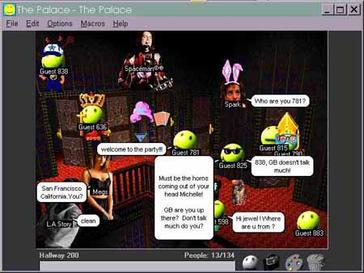
The default avatars in this chat were essentially 3D emojis (although this was before emojis made it to popularity). Being the emoji was a really interesting way to chat, and allowed something between full avatar and mood indicator to be reflected. I liked it a lot.
I see! I didn't realize HNGs were usually employed. Your perception of NEETs is generally correct, although it does also have a culture of being game/anime obsessed and being shut in to devote time to the internet, rather than being ostracized from the real world. But I'm sure there are both!
Wow! I LOVE the way that site looks. There's something about the chaos of the late 90s chatroom (and the mid 00s MySpace or Geocities page) that I find incredibly interesting. It's borderline tacky but so intentional it has it's own completely unique character! Those avatars remind me of AOL chatrooms as well. They were a bit before my time, but a few years back my friends played around on them through a virtual machine (before the servers were shut down). Rather than those large icons was a little emoticon next to the screen name usually meaning an emotion? I think that was AOL, although it could be any forum from that era.
Not silly at all! It's literally the most normal thing to work based off other people's actions. I totally agree with your sentiment that webspeak is used to convey emotion and tone. Do you happen to use emojis mid-sentence or would you say they function similar to punctuation?